An award transforms from a simple physical object into a prestigious symbol of achievement the moment craftsmanship meets personalization. The technique chosen to etch names, logos, and honors onto a trophy dictates how it catches ambient light, how substantial it feels in a recipient’s hands, and how beautifully it holds up on a display shelf years later.
Modern trophy design has shifted heavily toward minimalist geometric shapes, multi-material layering (like fusing raw wood with optical crystal), and advanced precision marking.
For high-end glass and optical crystal, nothing matches the prestige of deep sandblasting. This process involves masking the award with a high-resolution stencil and driving fine abrasive grit under intense pneumatic pressure to cut directly into the material surface.
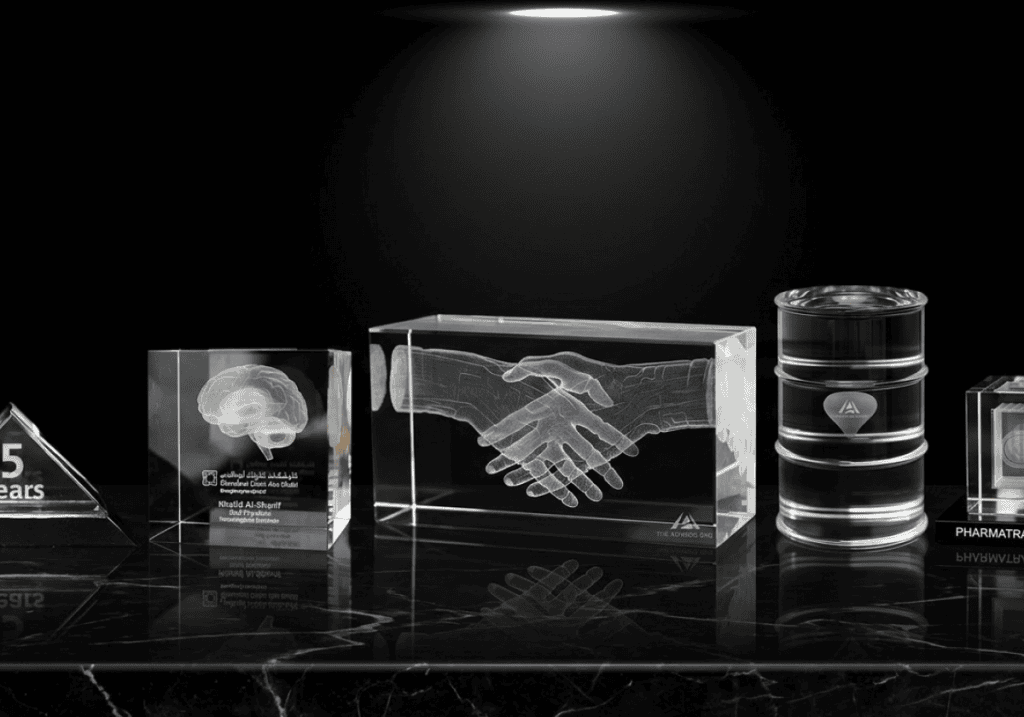
This technique uses a specialized laser that passes harmlessly through the polished exterior of a crystal block, focusing intensely at precise interior coordinates. The heat creates microscopic fractures inside the stone without scratching the outer walls.
Unlike CO2 lasers that handle non-metals, fiber laser systems are engineered specifically to mark metals with extraordinary resolution. In 2026, these machines are utilized to achieve fine jewelry-grade detail on minimalist metal trophies.
When working with premium organic hardwoods like walnut, oak, or mahogany, a CO2 laser burns directly into the wood grain.
To make text instantly legible on clear surfaces or to create an ultra-luxurious contrast on dark stone and crystal bases, deep engraving is paired with liquid paint or lacquer fill.
| Material Type | Recommended Technique | Visual Finish | Optimal Use Case |
| Optical K9 Crystal / Glass | Deep Sandblast Etching | Crisp, opaque matte white frost with physical depth | High-end corporate branding & lifetime honors |
| Premium Metals (Aluminium, Steel) | Fiber Laser or Rotary Diamond Drag | High-contrast dark marking or bright tactile metallic grooves | Minimalist geometric forms & sports championships |
| Hardwood (Walnut, Oak, Maple) | CO2 Laser Engraving | Warm, natural darkened carbon recess | Sustainable awards & text-heavy plaque bases |
| High-Grade Acrylic | CO2 Laser + UV Printing Combo | Smooth frosted edges mixed with full-color graphics | Modern, vibrant event branding & fast-turnaround trophies |
Pro-Tip on Contrast: When designing crystal awards, keep the surrounding space open. The elegance of sandblasting relies entirely on the stark contrast between the frosty, matte white engraving and the pristine, light-refracting clarity of the clear crystal around it.
For deep sandblast etching, it is best to keep text sizes at 8 points or larger. Script or highly ornate fonts with ultra-thin lines should be avoided or upsized, as lines thinner than 0.2 millimeters can lose their crisp definition or fail to hold the frosting evenly. Clean, sans-serif typography ensures effortless readability.
Engraving on the reverse side—known as second-surface or mirrored engraving—is a premium fabrication choice. By mirroring the design and etching it from behind, the text reads normally through the clear front face of the award. This leaves the front completely smooth, preserving the reflective, high-gloss prismatic quality of the crystal while giving the engraving a striking sense of three-dimensional depth.
Pure engraving (which physically removes material) is inherently monochromatic. However, exact Pantone matching is achieved using a hybrid approach. The award is deep-etched first, and then the recessed cavities are precisely hand-filled using color-matched industrial enamels. Alternatively, full-color logos can be applied via UV flatbed printing directly to the surface, and framed with traditional deep-etched text for the best of both worlds.
It depends on the design goal. Sandblasting is widely considered superior for luxury awards because it cuts deeper and yields a perfectly even, premium matte frost. CO2 lasers are incredibly fast and cost-effective, but because they micro-fracture the surface using rapid heat bursts, the resulting mark is shallower and can occasionally display tiny, uneven fractures on thick, high-lead crystal. Laser is best for tiny text or dense artwork; sandblasting wins for prestige.
When properly cured using high-grade automotive or industrial lacquers inside a deeply etched groove, color fills are incredibly permanent. They will not peel, fade, or flake under normal indoor display conditions. The physical wall of the crystal or metal groove protects the paint edges from friction and wear, keeping the award looking immaculate for decades.